EQUIPMENT page 2
MARK BANDO'S WEBSITE
Webmaster's Blog on Painted Helmets for sale on E Bay
and elsewhere
So, you watched Band of Brothers and you want to buy a paratrooper helmet with those neat spades painted
on the sides? Most of the ones in the film are real big, with flourishy spades and stems, like you see on
playing cards. You see examples on E Bay and most end-up selling for about $3,000- or more. You think they must be
real, if people are paying that much for them.
Better think again.
If you ever see 506th helmets for sale-especially if they are painted with 2nd Bn stencils, you had
best ASSUME they are fake.
Why? Because the originals were destroyed en-masse in 1945 and surviving examples are so rare, that they
barely exist. Units of the 101st never wore stenciled helmets in the states. Most of the few surviving examples
are still in Europe, either in some farmer's loft or in private collections. When any 506th helmet is offered for
sale, a red flag should go-up in your brain-these are the most-popular (because of BoB) and also the most
widely-faked helmets of all.
Overly-large spades are usually a giveaway, as well as the overly-large officer or nco bars usually found on the
rear. Those bars are supposed to be four inches long and about an inch wide. Overly-large stencils are the creation of fakers
and are the common mistake of reenactors. If you look at actual vintage photos of what was worn, the stencils were never that
large and usually about a third of the size of most fakes, or less.
XR Facts.com-(check out their website)-have scoped some known original vet-acquired painted 101st helmets with X ray technology
and recorded their data. For a fee, they can prove or disprove originals in a matter of seconds-this by the chemical composition
of the paint. All the crap that sells on E Bay in the way of painted helmets-well about 99% of them have been re-painted
after the war, usually last year or something. I have been talking to 101st WWII vets for 40 years and have uncovered less
than 10 bring-back painted helmets of all regiments/battalions, and none from the 506th.
I had a 506th officer tell me he brought his helmet back and gave it to his Grandson, but I never saw it and that is the
closest I've come to getting a 506th helmet directly from a vet. All those helmets were turned-in and destroyed or
re-cycled in 1945 and they just do not exist any more. The only 506th helmet in my collection came from Normandy, from the
old collection of Henri Levaufre, who had lived in France all his life and who was 14 in 1944 and who acquired the helmet
from a friend in St Come du Mont, shortly after the war ended. Some helmets from casualties did get picked-up by European
farmers and, most of the exisiting ones are over there, because 101st stenciled helmets in WWII were never worn in the states.
If a real 506th painted helmet ever does turn-up it ain't gonna be on E Bay if any dealer or knowledgeable collector has it.
It will change hands privately and it will sell for over $12,000-, probably more like 15k, if the item has real provenance
to a veteran. Most of the hump-job painted helmets sold on E Bay sell for around 3k, to people with the wishful thinking
syndrome, who assume that "it must be real if someone is charging thousands of dollars for it". You'd better think again,
because these blood suckers have absolutely no qualms about taking your money, the more the better.
The more artful fakers have become adept at artificially aging helmets to make them look over 60 years old, adding real names
or laundry numbers, etc. The best argument I can offer as to the rarity of real 101st painted helmets is for you to consider how
few I have uncovered in forty years and over 1,000 interviews with WWII vets of the 101st Airborne.
Please never spend your hard-earned money on any 101st painted helmet without posting the auction or seller pitch with
photos on the forum of my website. Then, if you are gonna spend thousands, get a money-back guarantee and spend the
requisite money to have the item scoped by XRFacts(check-out their website). They also do German helmets.
I have a total of SIX WWII 101st painted helmets in my collection. Four came directly from vets and the other 2 from
Normandy (those came as pots-only, even missing the chinstraps). Three of the four 101st helmets I got direct from vets
belonged to officers-they had a better chance of evading the orders to turn-in helmets. The fakers know this, which is why
they produce a large percentage of supposed officer helmets from their fake mills. My 327th helmet came from a farm at S
Pellerin, where the woman was using the pot to feed oats to her horses. I asked Brooks Bush to do 'historical restorations'
to that and my 506th pot, by replacing the chinstraps on both of them.
When I look at the original painted helmets in my collection, they don't look any better than some of the more
realistically done re-paints. Then, when I think of how little they are appreciated by most people, I realize that the fact
that they were actually worn by a real 101st trooper in WWII is not important to most people. When you can get a re-paint
that looks comparable, why spend 12k plus, for something that only a tiny number of people actually appreciate the significance of?
If you just want a representative piece, that looks real, get one that was re-painted with the right size/shape of stencils and
don't pay over $300- for it.
If helmets could talk, there would be a real advantage to owning an original, but at the end of the day, even my real ones
are just paint, metal and webbing. Not one percent of the population would ever know the difference between them and an
E Bay hump job-this is just another perspective to consider.
In my books and on page three of the Insignia chapter of this website, are vintage photos showing what actual stencils
looked like. Those are references you should pay attention to. If I was you, I'd give-up on the idea of ever having an
original 506th painted helmet and have one artfully created, with the stencils copied from a wartime photo and then pay what
it is really worth (no more than $300-). Put it on your mantle and look at it while watching BoB and consider all the things
I mentioned above.
I should point-out in closing, that some of the repro helmet makers have created masterpieces of deception with no intent to
defraud anyone. If you buy a re-painted helmet, KNOWING what it is, AND you pay an appropriate amount for it, that is no problem.
The trouble is, that with so much money to be fraudulently made, the unscrupulous will always exploit such situations and
use the opportunity to make obscene and unprincipled profits from the ignorant and unknowing. When they get their hands on a
hump job product, whether it is a 'named' Ike jacket, a recently-modified pair of M43 trousers, or a re-painted helmet, they
are not going to tell a prospective buyer it's a hump job. The dealer can claim (legitimately or falsely), that he didn't
really know for sure and at the end of the day, it is the buyer's job to ensure he doesn't get screwed.
BUYER BEWARE!!!
WW2 101st Airborne Helmets With Provenance
D Bale Helmet of Dom Speranza, HQ/3, 501 PIR
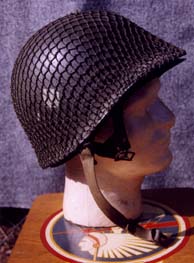 Dom was in the LMG platoon of 3/501 and was issued this helmet at Camp Toccoa, GA in late 1942. He also wore it at Ft. Benning, Camp Mackall, N.C., 2nd Army Maneuvers in Tennessee, in Lambourne,England and in Normandy. He was issued the small mesh British-made helmet net depicted, for the Market Garden jump. While in Holland, Dom was evacuated for medical reasons and he brought the helmet out through the hospitals with him. I acquired it from him in 1976, my first painted helmet, complete with original net and a D bale at that.
Note the positioning and small size of the diamond-shaped stencil, as well as it's proportions(it is a perfect square, rotated with one corner up, to make it a diamond). Although some vintage stencils were much larger, today's reenactors tend to make their stencils way too large. When doing 501st stencils, they tend to make them elongated diamonds, instead of rotated squares.
The A/501st trooper on a white horse depicted in episode #3 of the Band of Brothers miniseries, had an annoyingly elongated diamond stencil painted on his helmet.
PAINTED D-RING HELMET OF LTC BENJAMIN WEISBERG, C.O. 377th
PARACHUTE FIELD ARTILLERY BN.
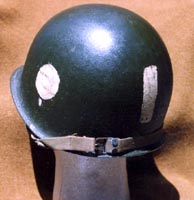
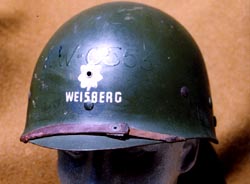
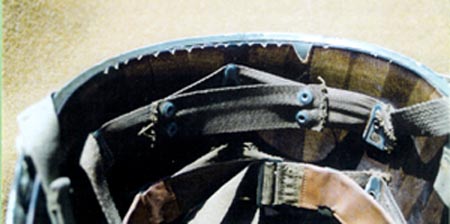 This helmet was worn by LTC Weisberg on 16 parachute jumps, including the Normandy drop, and
was re-painted just after Normandy. Note the cannonball stencil
with 'tic' at the 6 o'clock position, and the vertical officer's bar on the center rear, in the top left photo. A frontal view of the helmet liner at top right, shows that his serial number, rank and name were applied (a metal leaf rank is mounted on the front of the steel pot). No unit stencils nor officer's bar appear on the liner, and it is believed that units began applying liner stencils after the Holland campaign. LTC Weisberg left the 101st after Normandy. (Some information about that apppears in my 4th book, which is now available.) Another unique aspect of how Ben Weisberg personalized his helmet can be seen in the bottom photo. He cut a small notch for each parachute jump he made on the bottom rear rim of the helmet liner. The large notch is presumably for the combat jump into Normandy. As artillery liason to the 502 PIR, he jumped right behind Colonel George V.H. Moseley near Drop Zone 'A'on D-Day.
This helmet was worn by LTC Weisberg on 16 parachute jumps, including the Normandy drop, and
was re-painted just after Normandy. Note the cannonball stencil
with 'tic' at the 6 o'clock position, and the vertical officer's bar on the center rear, in the top left photo. A frontal view of the helmet liner at top right, shows that his serial number, rank and name were applied (a metal leaf rank is mounted on the front of the steel pot). No unit stencils nor officer's bar appear on the liner, and it is believed that units began applying liner stencils after the Holland campaign. LTC Weisberg left the 101st after Normandy. (Some information about that apppears in my 4th book, which is now available.) Another unique aspect of how Ben Weisberg personalized his helmet can be seen in the bottom photo. He cut a small notch for each parachute jump he made on the bottom rear rim of the helmet liner. The large notch is presumably for the combat jump into Normandy. As artillery liason to the 502 PIR, he jumped right behind Colonel George V.H. Moseley near Drop Zone 'A'on D-Day.
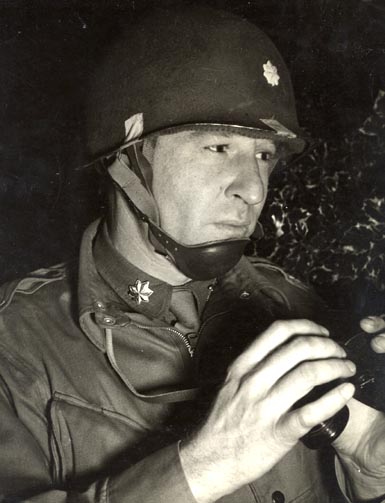 This portrait of LTC Weisberg was made in England on a night maneuver prior to D-Day. His steel pot had not yet been painted with the Cannonball and tic stencil. He placed tape from the pot to the liner, to discourage them from separating while jumping. Note how he also braided his steel pot chinstrap around the leather strap of the chincup for additional stability.
The M42 jacket's knife pocket for his M2 jumpknife is unzipped and wide open. S.C. photo courtesy Nadine Wierzbowski collection
DETAIL OF ORIGINAL 'D' RING RETAINER
This portrait of LTC Weisberg was made in England on a night maneuver prior to D-Day. His steel pot had not yet been painted with the Cannonball and tic stencil. He placed tape from the pot to the liner, to discourage them from separating while jumping. Note how he also braided his steel pot chinstrap around the leather strap of the chincup for additional stability.
The M42 jacket's knife pocket for his M2 jumpknife is unzipped and wide open. S.C. photo courtesy Nadine Wierzbowski collection
DETAIL OF ORIGINAL 'D' RING RETAINER
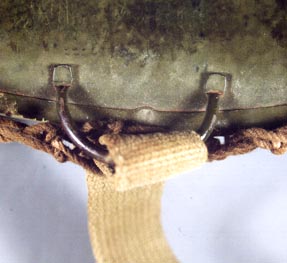 This is a view of the D Bale chinstrap retainer on the edge of LTC Weisberg's helmet, an example of how they looked when issued. Since this example was never repaired or reinforced by the Riggers, there is no spillover on the neat weld job and certainly no overriding lumps as seen on the braised D rings of Don Hettrick's helmet, pictured below.
D Bale Painted Helmet of Lt Hettrick D Battery 377th PFA Bn
This is a view of the D Bale chinstrap retainer on the edge of LTC Weisberg's helmet, an example of how they looked when issued. Since this example was never repaired or reinforced by the Riggers, there is no spillover on the neat weld job and certainly no overriding lumps as seen on the braised D rings of Don Hettrick's helmet, pictured below.
D Bale Painted Helmet of Lt Hettrick D Battery 377th PFA Bn
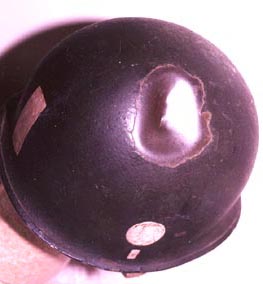
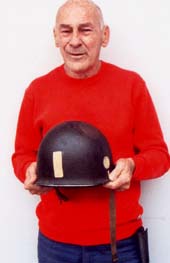 Forward observer Don Hettrick was on a patrol with the infantry behind German lines in Holland, September, 1944, when a shootout errupted. In the confusion, Don lost his helmet behind enemy lines and was unable to retrieve it.
Shortly thereafter, Lt Hettrick visited another field, where heavy fighting had recently taken place. He examined a number of abandoned helmets, seeking a replacement. The first helmet he looked at had a hole in the crown and he found a piece of human skull as large as the palm of his hand, wedged betwen the steel and liner.
Don finally located the D bale helmet shown above and managed to get white paint to add stencils for his rank and unit, the 377th PFA Bn. (The prior owner's identity and unit are unknown). Shortly after this, Don hit the ground in front of his C.P. during an extended German artillery barrage. A shell fragment struck the crown of his pot, near the right rear, and inflicted a dent several inches in diameter and 1/2" deep. At the deepest part of the dent, the steel is slightly split open. Despite a verbal directive from LTC Handlebar Hank Elkins to discard the helmet, Don continued to wear it, through Holland, Bastogne, Alsace, and Germany.
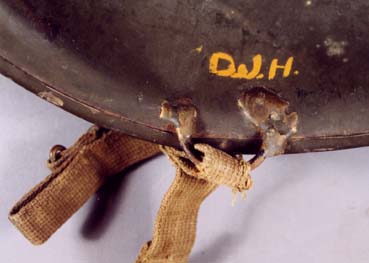 This shot shows a detail of the 'D' loop chinstrap retainer on Lt Hettrick's steel pot.
The straps are set-up with snaps, for attaching the pot to the jump liner, and the posts of the D rings have been reinforced or reattached, with a lumpy brass-colored metal, indicating a braze job, probably by the Para Maintenance (Riggers) Section. On this side of the inner pot, Don painted his initials:"DJH", for Don J. Hettrick, about 3/8" high, in yellow paint.
This shot shows a detail of the 'D' loop chinstrap retainer on Lt Hettrick's steel pot.
The straps are set-up with snaps, for attaching the pot to the jump liner, and the posts of the D rings have been reinforced or reattached, with a lumpy brass-colored metal, indicating a braze job, probably by the Para Maintenance (Riggers) Section. On this side of the inner pot, Don painted his initials:"DJH", for Don J. Hettrick, about 3/8" high, in yellow paint.
note: All helmet bales were neatly welded at the factory, but they tended to break off. The Riggers replaced broken bales by braising, and also reinforced some unbroken ones, to help keep them from breaking in the future.
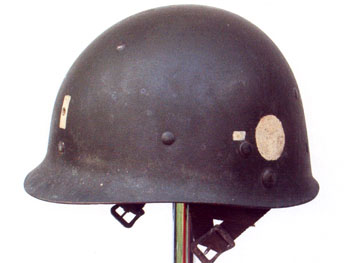 In spring, 1945, Don was transfered to the 907th GFA Bn, with which he ran a POW compound at Bad Reichenhall, Germany. At that time, Don had 907th Bn stencils applied to the liner of his helmet, as shown above. It appears the liner was without stencils prior to that.
Identification Markings
In spring, 1945, Don was transfered to the 907th GFA Bn, with which he ran a POW compound at Bad Reichenhall, Germany. At that time, Don had 907th Bn stencils applied to the liner of his helmet, as shown above. It appears the liner was without stencils prior to that.
Identification Markings
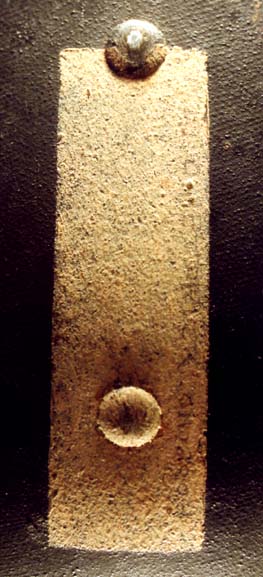 Pictured above is the vertical officers' bar on the rear of the liner of Lt. Hettrick's helmet. If you look closely, you'll see that he wrote his name and serial number, in small fountain pen figures at the vertical right edge of the stencil.
PAINTED FIXED BALE HELMET OF CECIL SIMMONS
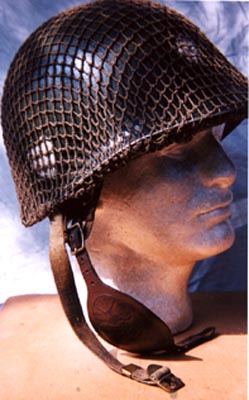 Cecil Simmons wore this helmet from Holland to Austria, and it has 3/502 stencils, as well as LTC rank and a rear vertical officers' bar painted on both the pot and liner. Simmons told me his original D ring helmet was shot off in Normandy and he discarded it, because it had bullet holes in it. The bales on this helmet are attached or reinforced with a lumpy, gold-colored weld, but Para Maintenance could have made any number of modifications before he received it. The chin straps on the pot have a nickel snap added to each side for attachment to the liner. Since this was done using the existing material, it resulted in shortening the straps on each side from their as-issued configuration. Simmons was the last officer to command Third Bn. of the Deuce and was the only commander of that battalion to survive WW2, after the deaths of Cole and Stopka.
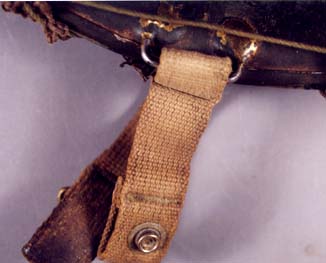 A detailed shot of the inner rim of Simmons' fixed bale pot. This shows the same type of gold-colored, lumpy braising which reinforced the D bales of Lt. Hettrick's pot. Another D bale pot picked-up by a Norman farmer near la Croix, (which I observed in 1989), exhibited the same lumpy braised repair or reinforcement at the points where the bale attached to the rim of the pot. Evidently, this procedure was quite a commonplace WW2 era repair to 101st helmets.
Found in Normandy
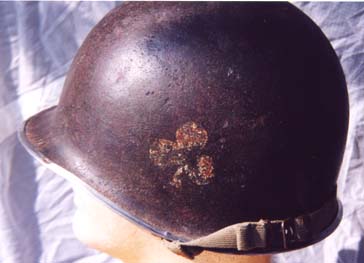
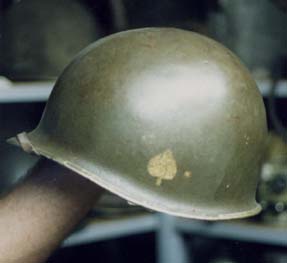 I got the 1/327th GIR steel pot from my French friend, Christophe Parey, formerly of la Barquette. He found it at a farm in St. Pellerin (east of Carentan) in the late 1980s. A French farm woman was feeding oats to her horse from the pot at that time. Although the pot has lost a lot of paint over the decades, one stencil is mostly intact and the other is at least recognizable. The pot was found without straps or liner. I hired Brooks Bush to do a 'historical restoration', which is to say, he has replaced the chinstraps on the pot.
The helmet at right was found near St Come du Mont and wound-up in the collection of historian Henri Levaufre at Perriers. Since the 1st and 3rd battalions of the 506th both went into France with the same stencils (tic at 3'oclock), the only way to tell that this helmet was for a 3rd battalion company, is the two dots painted on the center front and rear.
Both of these helmets have fixed bale chinstrap retainers.
Lt Williamson's Bastogne Helmet
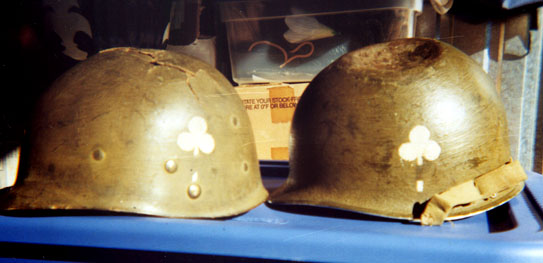 This helmet was submitted by Neal, a frequent visitor to this site. It was obtained from the son of Cpl. Willard Williamson, an E/327th trooper, who had it in a German box. Great find! There is battle damage to the crown: a dent 4 inches wide and 2 inches deep in the pot, and the crown of the liner broken and caved-in. This resulted from being struck by falling debris at Bastogne while running down the street under an artillery barrage. Williamson was slightly wounded, but was denied a Purple Heart, because this type of injury was commonplace at Bastogne. The rear of the helmet bears a small rank insignia, painted on the rear of the liner.c/o NPJ collection
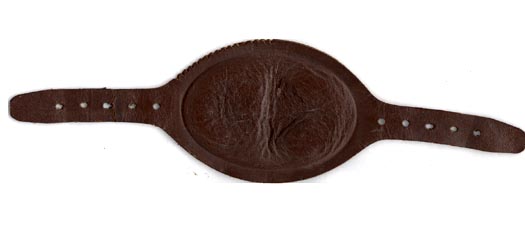 Although difficult to see in this scan, Clarence Theaker, a jumping member of 101st DIVARTY, cut 17 small notches on the edge of this leather chincup, to keep score of his parachute jumps.
Still in the Woodwork
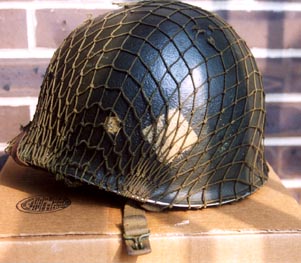 A 501st PIR rifleman of 3rd Bn who was wounded in Normandy, brought this D-ring helmet home; he still owns it. It was never re-painted after Normandy and has the original stencils and net. Note the dark green paint, the color and mesh size of the net, and the fact that the stencils are both large and rough-edged, indicating freehand painting. Stencils tended to get smaller as the war progressed. A Sgt named Euel Langlinais of H/501, was killed at Eerde, Holland in September, 1944 when a Kraut sniper put a round right through the diamond on the side of his helmet. He had been an NCO instructor at The Parachute School, before joining the 501.
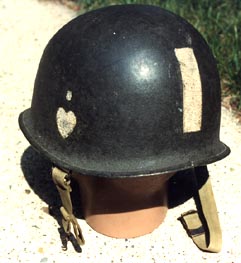 The steel pot above was issued to a 502 officer at Bastogne, when he returned to the unit after being wounded in a prior campaign. It is a standard swivel bale pot, with no extra snap added to attach to an Airborne liner.
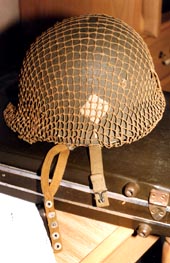 This helmet was worn by a member of 2/501 on the Holland jump. This man was a replacement and joined 501 after Normandy. It is a fixed bale helmet with as-issued straps on the pot. Note the mesh size, and color of the net. Most nets of this period are of a slightly smaller mesh, dark green in color and of Brit manufacture. This is also evidence that the tan colored split chin strap of web material was in use by the time of Market Garden. Note also the large pot-metal buckle on the 'V' strap of the liner. This was characteristic of one particular manufacturer. I found one with my metal detector at the site of the H/501 plane that crashed near Dead Man's Corner. As there was only one paratrooper aboard when that plane went-in I assume the buckle came from the helmet of John S. Pegg. That is evidence that such buckles were in use by the time of the Normandy jump. One other detail of interest on the helmet above, are the strings from a tear-open first aid kit which the owner had tied to the net on the rear of his helmet. When he cut the kit off to give aid to a wounded buddy at Veghel, the strings remained in place and are still there.
Jump Knives, Type M2
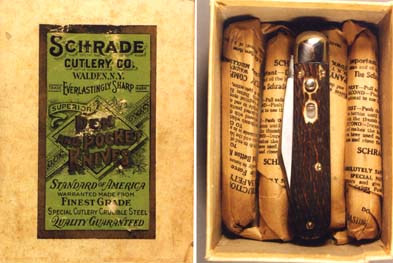 This original manufacturer's box from the Schrade Cutlery Company, contains six unissued knives, Type M2, each wrapped
in a piece of waxed paper, with instructions on how to use the knives printed on each wrapper. The end of the box has a
ink stamp that says "1/2 Doz No. M 2".
This original manufacturer's box from the Schrade Cutlery Company, contains six unissued knives, Type M2, each wrapped
in a piece of waxed paper, with instructions on how to use the knives printed on each wrapper. The end of the box has a
ink stamp that says "1/2 Doz No. M 2".
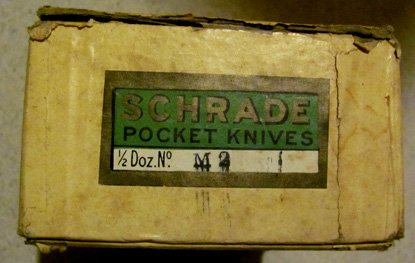 The M2 marking singularly identifies these as knives intended for military use.
The officer who saved these knives from destruction was Captain Robert Speer.
The 551st PIB was leaving Panama to transfer to Camp Mackall, N.C. in 1943. Many items like this were being tossed in a
large fire, as all new equipment was to be issued at Camp Mackall. Speer saved two boxes of these early type jump knives,
with picked bone handles. He gave one box of them away after WW2, one at a time. Note these early knives lack the
lanyard staple on the ends of the handles. Probably by popular request, those were added later in WW2. After
transfering for a brief period to the 542nd PIB, Speer went to the 101st Airborne, joining them in England after the
Normandy campaign. He was later made company commander of HQ/2, 502 PIR.
101st Airborne
Switchblades
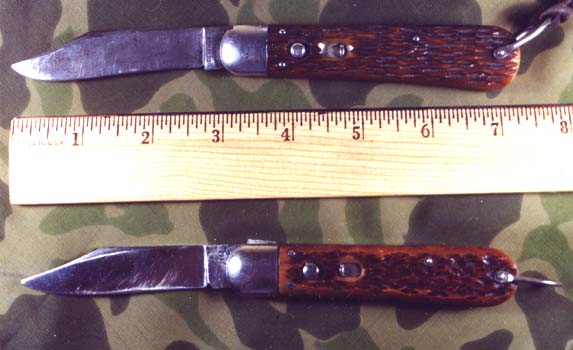 Only two types of M2 knife have been observed by me, in the hands of 101st vets
1) a type with staples, on brown picked-bone handles, having the same size and blade markings as the 551` types, including the early patent numbers on the reverse of the ricasso. I've seen 4 examples of those in the hands of 101st vets, and owned 2 of them. All of them DID have staples on the handle, which seperates them from the early types, without staples. As I think about it, one of the 4 vets was in G/501, the other 3 were in I/506th. These type knives are marked
Schrade Cut.Co.
Walden NY
on the obverse of the ricasso
On the reverse, they are marked:
U.S.Pats.
Dec.21.09.
Sept.13.10.
June 6.16.
The blades are about 3" long, and the overall length of the knife, with blade opened, is 7&1/4".
2) The only other type of M2 knife I've obtained directly from 101st vets, is the type marked:
PRESTO
PAT PEND-G
on the obverse of the ricasso, with
G.SCHRADE
B'PORT. CT.
on the reverse.
These knives have brown picked-bone handles, and are seen much more often then the type described above-evidently, a lot more of these were issued. An almost identical type knife was on the civilian market, but those Prestos have patent numbers on the reverse, whereas the issued ones say only G.Schrade B'Port, Ct.
on the reverse side. Other than the patent markings, some Army and Civilian PRESTOs are identical. However, other civilian market PRESTOs exist in varying lengths, and also a type with black-painted metal handles, instead of picked-bone. There is a postwar M2 knife with black plastic handles, marked
"Schrade Walden"
on the obverse of the ricasso, but those began in production in 1947, when the Schrade brothers from Ct and NY merged factories.
Final comments about the PRESTO type issued to the 101st:
1) The blade shape is the same as on the Schrade Cut.Co. types, and the blade length is also 3", but the overall length of the PRESTO, is about 1/4" shorter than the Schrade Cut Co type.
2) I've seen that about 30-40 percent of both these types of knives have blued steel bolsters and blades, which I think was done by the troopers themselves, to tone down the bright appearance of the metal parts for combat. I've seen this on 2 SCHRADE CUT CO type knives, and on almost half of the PRESTO knives I've examined.
Para Gloves
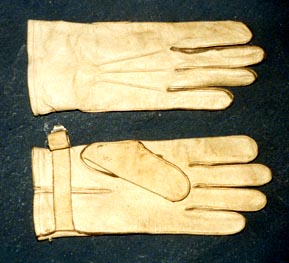 Several types of tan leather gloves were issued to paratroopers,
the most common style having adjustment straps at the wrist, as shown above. These gloves were optional wear for jumping,
but Sgt J.P. Knight, a former TPS instructor told me they stopped making students wear them after one student absent mindedly
wrapped the static line around his fingers and held onto it when exiting. Four pieces of leather were later found, each
with a finger inside: "...no more jumping students with gloves on." Colonel Jumpy Johnson liked these tan gloves so much
that he made them required wear with the Class 'A' uniform on parades starting in Camp Toccoa, GA.
Several types of tan leather gloves were issued to paratroopers,
the most common style having adjustment straps at the wrist, as shown above. These gloves were optional wear for jumping,
but Sgt J.P. Knight, a former TPS instructor told me they stopped making students wear them after one student absent mindedly
wrapped the static line around his fingers and held onto it when exiting. Four pieces of leather were later found, each
with a finger inside: "...no more jumping students with gloves on." Colonel Jumpy Johnson liked these tan gloves so much
that he made them required wear with the Class 'A' uniform on parades starting in Camp Toccoa, GA.
Para gloves from the collection of Dennis Davies, Salem, NH.
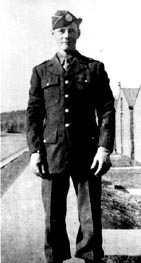
The image below shows Tommy Coyne of F/501, wearing the tan gloves with his class'A' uniform at Toccoa.
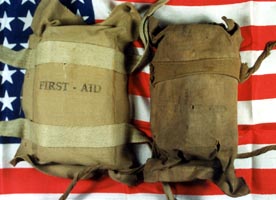 No, it's not Mr & Mrs Potato Head-shown above are two Parachutist First Aid Kits. One is shown looking as-issued. The other was worn in Normandy, Holland, Bastogne, and Germany by Sgt Al Milakeve of G/501. The kit consists of a brown cloth bag with 2 tie strings affixed (running across to form four ties), which were used to fasten the kits to belts, ankles, arms, suspender harnesses, knife scabbards, and later, helmet nets. The contents included a Carlisle bandage in cardboard box, a cloth torniquet, sulfanilimide powders in an envelope, and a one-shot disposable morphine syrette. Because of the Morphine contents, some efforts were made to inventory and recall unused kits after each mission.
 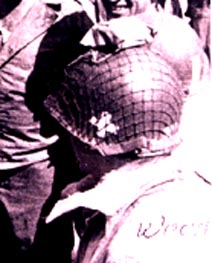 The photo above shows the aid kit in wear, tied to the top of a helmet net-this is among the earliest known photos showing this practice. It was taken in Normandy near Chateau Colombieres in June, 1944. The trooper, whose helmet was also painted with the white Geneva Cross of the 326th Airborne Medical Company, was S/Sgt John "Woody" Woodrich.
During Market-Garden, the practice of wearing these kits tied to the helmet net had become widespread. I've only seen photos of three 101st men wearing them that way in Normandy.
Flag Brassards
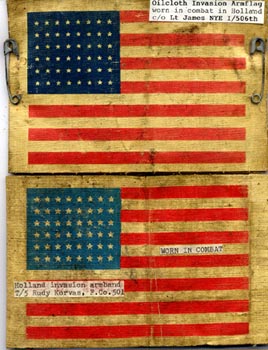 Although also a form of Insignia, I've decided to class these arm brassards with Equipment, as they were primarily worn on a combat jump. The purpose was to identify the nationality of the wearer to the locals of the country being invaded. These oilcloth armbands had been around for a year or two before the 101st used them. U.S. amphibious forces had already worn similar arm brassards in 1942, in Operation Torch-the landings in North Africa. Earlier examples usually have the top and bottom edge folded over and sewn. Eventually, it was discovered that this was an unnecessary and time-consuming frill, so that feature was eliminated by 1944. Although brassards like those shown above were worn by everybody in the 101st Airborne during the Market-Garden operation, photographic evidence indicates that they were not generally worn in Normandy by the 101. Some esoteric sub units, such as the 501st Pathfinders, departing from North Witham airfield, may have worn them, but such instances in Normandy were few. The 82nd Airborne DID wear armflags in Normandy, some of a narrower oilcloth version, or a small, flimsy gauze version. The two types shown above, were both issued with a pair of carbon steel safety pins. The flag brassard was much longer than shown, but was generally folded and pinned to the upper right sleeve. The top example from Lt Jim Nye, who variously served with I,F, and RHQ companies of the 506th, has a dark blue field behind small stars. The lower version, worn by Rudy Korvas of F/501 is the more common type, with larger stars on a lighter blue field. This 2d type was also more prone to color fading. Actual size of each flag when folded as shown is 3&7/8" by 5&7/8".


